
Developing quantitative approaches to understand genetic variation, development, and disease
Quantitative methods development has been a central part of the Conrad Lab’s research for more than two decades. We develop computational tools and data resources to address challenges that emerge from our research, while also applying and integrating emerging genomic technologies to understand genetic variation, development, and disease.
Our research has produced computational methods, software, atlases, and interactive resources that enable new ways to analyze, integrate, and interpret complex genomic and molecular data.
From development to adulthood
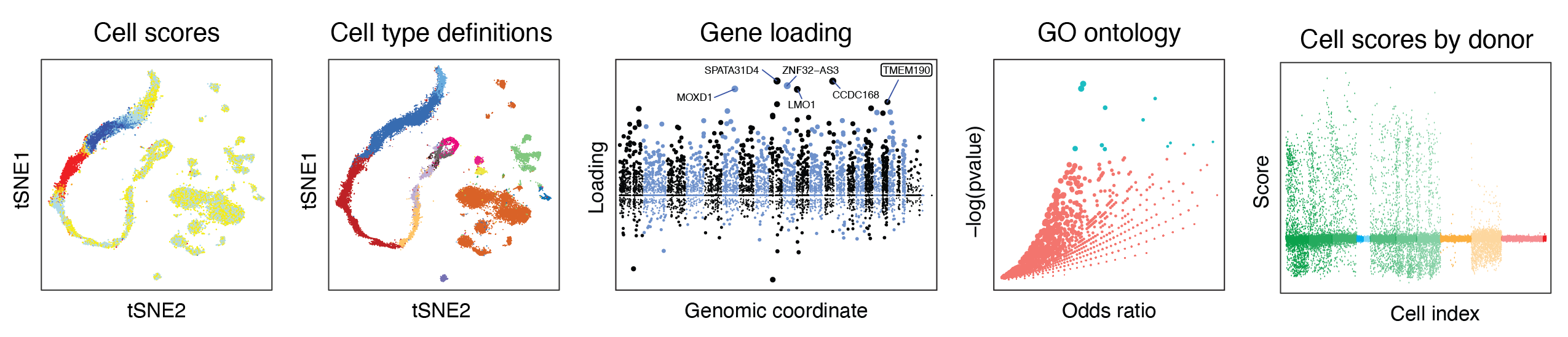
Adapted from Mahyari et al. Am J Hum Genet. 2021
Exploring male gonad development at single-cell resolution
DG-SEA (Developmental Gonad Single-Cell Expression Atlas) is an interactive single-cell atlas of male gonad development spanning embryonic, fetal, and early postnatal stages. Designed as a developmental companion to HISTA, it enables researchers to explore cell types, gene expression, and developmental gene programs across critical windows of gonad formation. These data provide developmental context for investigating candidate genes and understanding the origins of male infertility.
An integrated molecular reference of the human testis
HISTA (Human Infertility Single-cell Testis Atlas) integrates human testis single-cell RNA-seq datasets across donors, developmental ages, and fertility states into an interactive molecular reference. Researchers can explore cell-type-specific gene expression, developmental regulation, and molecular changes associated with impaired testis function, providing a resource for interpreting the biology and genetics of male infertility.
Making complex genomic data accessible and explorable
Exploring gene expression in its spatial context
SpaTA integrates spatial and single-cell transcriptomic data from the testis into an interactive resource for exploring gene expression within the context of tissue architecture and cell identity. By connecting molecular profiles with their physical location in the testis, SpaTA enables researchers to investigate the spatial organization of testis biology across species.
Exploring genetic variation in male infertility
The Male Infertility Variant Browser brings together genomic variation from large cohorts of men with infertility and clinically characterized controls. Designed to complement general population databases, the resource will enable researchers to examine variant frequencies and annotations in a disease-relevant population, supporting gene discovery and the interpretation of genetic variation associated with male infertility.
Quantitative and computational approaches for interpreting genomic and biological data
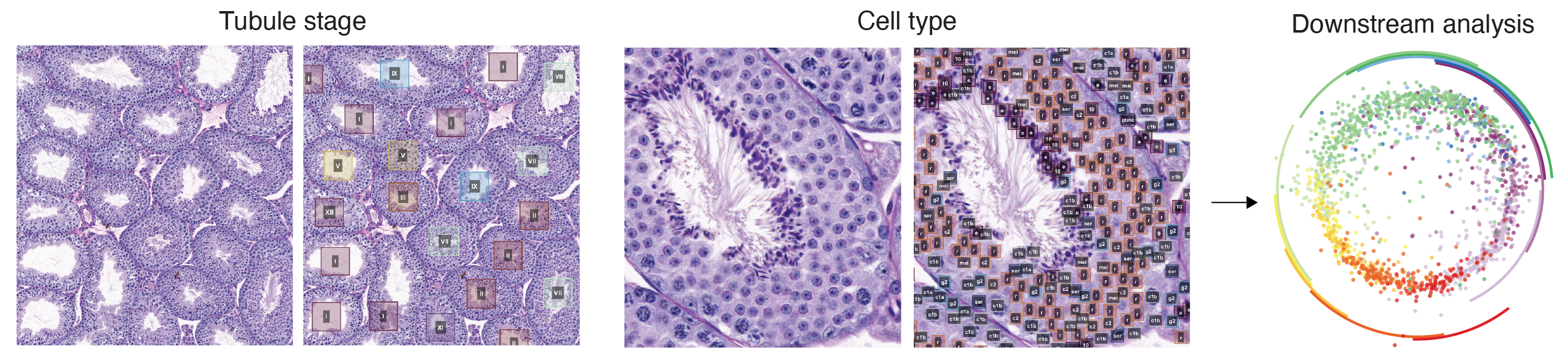
Using SATINN: adapted from Yang et al. Biol Reprod. 2025
Automated quantitative analysis of testis histology
SATINN (Segmenting and Assigning Testis cell types from histology images using Neural Networks) combines deep learning and computer vision to automate the analysis of testis histology. By identifying and classifying cells and seminiferous tubules across whole-slide images, SATINN transforms traditionally labor-intensive histopathology into a scalable quantitative phenotype. Continued development has expanded the approach across imaging platforms, experimental datasets, and laboratories.
Prioritizing potentially disease-causing genetic variation
PSAP (Population Sampling Probability) is a statistical framework for identifying unusually rare and potentially disease-causing genotypes in individual genomes using population genetic variation. Originally developed for rare-disease variant prioritization, the framework has since expanded through complementary tools and approaches.
Easy-PSAP provides an integrated workflow for applying PSAP to exome and whole-genome sequencing data, while PSAP-genomic-regions extends the framework beyond genes to evaluate coding and noncoding variation across genomic regions.
De Novo Mutation Discovery
A statistical framework for identifying de novo mutations from high-throughput sequencing data, developed to improve the sensitivity and specificity of mutation discovery.
Comorbidity Database Mapper
Integrates genotype–phenotype information across model-organism databases to investigate relationships among reproductive phenotypes, genetic disease, and comorbidities across species.
In addition to developing our own computational tools and resources, we apply and integrate emerging genomic technologies with quantitative approaches to investigate genetic variation, development, and disease.
Resolving biological complexity one cell at a time
Single-cell RNA sequencing allows us to dissect complex tissues into their component cell types and states and determine how gene-expression programs change across development, health, and disease. We use single-cell genomics extensively to study testis development and function, male infertility, and primate development, integrating datasets across individuals, developmental stages, tissues, and species.
Importantly, we do not simply generate single-cell datasets. We develop computational approaches and resources—including HISTA and DG-SEA—to integrate, interpret, and make these complex data accessible to the broader research community.
Connecting gene expression with tissue architecture
Spatial transcriptomics adds a critical dimension to genomic analysis by preserving information about where gene expression occurs within a tissue. We use spatial approaches to investigate how molecular programs are organized within the testis and how relationships among cells and their local environments contribute to development, normal function, and disease.
By integrating spatial transcriptomics with single-cell data, histology, and computational analysis, we can connect molecular cell states with tissue structure and investigate biological processes across multiple levels of organization.